Pain Relief Resources for Louisville, KY
Learn what’s really causing your pain—and how to fix it naturally.
We created these resources to help you better understand your body,
your pain, and your options—so you can make informed decisions about your health.
Recent blog posts
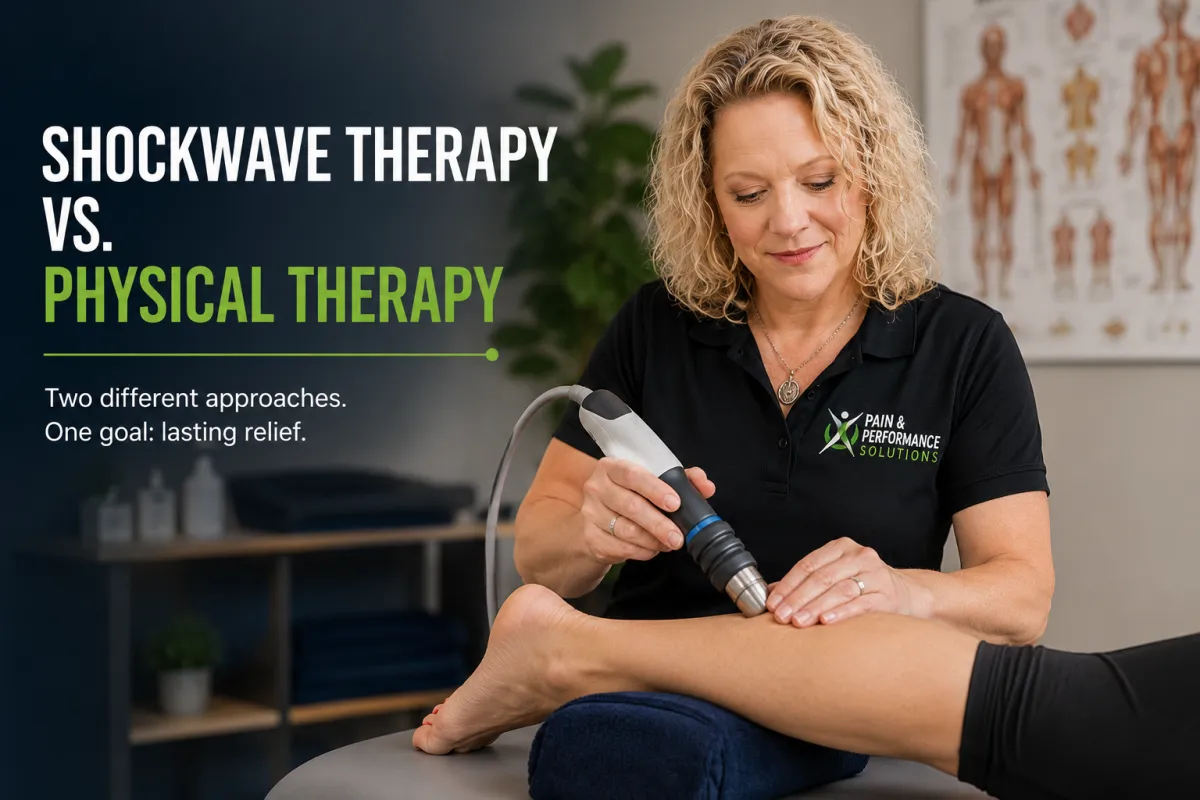
What Makes Shockwave Therapy Different From Physical Therapy?

What Makes Shockwave Therapy Different From Physical Therapy?
If you've been struggling with chronic pain, tendon injuries, plantar fasciitis, or stubborn movement limitations, you've likely heard about both physical therapy and Shockwave Therapy.
Many people assume they are the same thing.
While both approaches aim to help you move better and reduce pain, they work very differently.
Understanding these differences can help you determine which treatment may be right for your condition and goals.
What Is Physical Therapy?
Traditional physical therapy focuses on improving movement, strength, flexibility, balance, and function.
Treatment may include:
Corrective exercises
Stretching programs
Manual therapy
Balance training
Movement retraining
Education and activity modification
Physical therapy addresses how the body moves and functions.
It is often highly effective for improving mobility, restoring strength, and helping patients recover from injury.
What Is Shockwave Therapy?
Shockwave Therapy uses high-energy acoustic waves that are delivered directly into injured or dysfunctional tissue.
These acoustic waves help stimulate the body's natural healing response.
Shockwave Therapy may help:
Increase blood flow
Stimulate tissue repair
Break up chronic scar tissue
Improve cellular activity
Reduce pain sensitivity
Accelerate healing processes
Unlike treatments that simply mask symptoms, Shockwave Therapy works to stimulate healing within the affected tissue itself.
Why Chronic Injuries Often Struggle to Heal
Many chronic pain conditions involve tissues that have entered a stalled healing cycle.
Examples include:
Plantar fasciitis
Achilles tendon pain
Tennis elbow
Golfer's elbow
Rotator cuff tendon pain
Patellar tendon pain
These conditions often persist because the body has difficulty restarting the healing process.
Shockwave Therapy helps create a biological response that encourages the body to resume repair and regeneration.
The Biggest Difference Between Physical Therapy and Shockwave Therapy
The simplest way to understand the difference is this:
Physical Therapy focuses primarily on improving movement and function.
Shockwave Therapy focuses primarily on stimulating healing within damaged tissue.
In many cases, the two treatments work extremely well together.
Improving movement without addressing tissue healing may limit results.
Stimulating tissue healing without correcting movement dysfunctions may also limit long-term success.
This is why many patients benefit from a comprehensive approach.
Conditions That May Benefit From Shockwave Therapy
Shockwave Therapy is commonly used for:
Plantar fasciitis
Achilles tendonitis
Tennis elbow
Golfer's elbow
Patellar tendonitis
Rotator cuff tendinopathy
Chronic tendon pain
Calcific shoulder conditions
Many patients seek Shockwave Therapy after other conservative treatments have failed to provide lasting relief.
What Does Treatment Feel Like?
Most patients describe Shockwave Therapy as unusual but tolerable.
You may feel:
Mild discomfort
Deep pressure
Pulsing sensations
Treatment sessions are typically brief and require little to no downtime.
Most people can return to normal activities shortly afterward.
How Pain & Performance Solutions Uses Shockwave Therapy
At Pain & Performance Solutions, Shockwave Therapy is often combined with movement assessment and root-cause evaluation.
Rather than simply treating symptoms, we look at:
Why the injury developed
What movement patterns contributed
Whether compensation patterns are present
How to optimize long-term recovery
This combination often creates better outcomes than addressing tissue pain alone.
Is Shockwave Therapy Right for You?
If you've been dealing with chronic pain, recurring tendon injuries, or a condition that hasn't responded well to traditional treatments, Shockwave Therapy may be worth considering.
A Discovery Visit can help determine whether it's an appropriate option for your specific condition.
Ready to Learn More?
If chronic pain is limiting your ability to do the things you love, we may be able to help.
Schedule your Free Discovery Visit with Pain & Performance Solutions today.
📍 Louisville, KY
📞 502-276-7222
Discover whether Shockwave Therapy could be the missing piece in your recovery.

Book Your Free
Discovery Session
No pressure. No obligation. Just clarity
In your 30-minute session, you’ll:
✔ Get clear on what’s actually causing your pain
✔ Understand your options
✔ Know if we’re the right fit for you
How It Works
1. Fill out a quick form
2. We’ll reach out to learn more about your situation
3. Schedule your free session

Call Us
For immediate assistance or to speak directly with one of our experts, feel free to give us a call.
(502) 276-7222

Visit Us
Drop by our shop to receive personalized service and discuss your needs face-to-face.
9900 Shelbyville Rd Suite 1A, Louisville KY 40223

E-mail Us
Have a question or need more information? Send us an email, and we'll get back to you promptly with the details you need.