Pain Relief Resources for Louisville, KY
Learn what’s really causing your pain—and how to fix it naturally.
We created these resources to help you better understand your body,
your pain, and your options—so you can make informed decisions about your health.
Recent blog posts
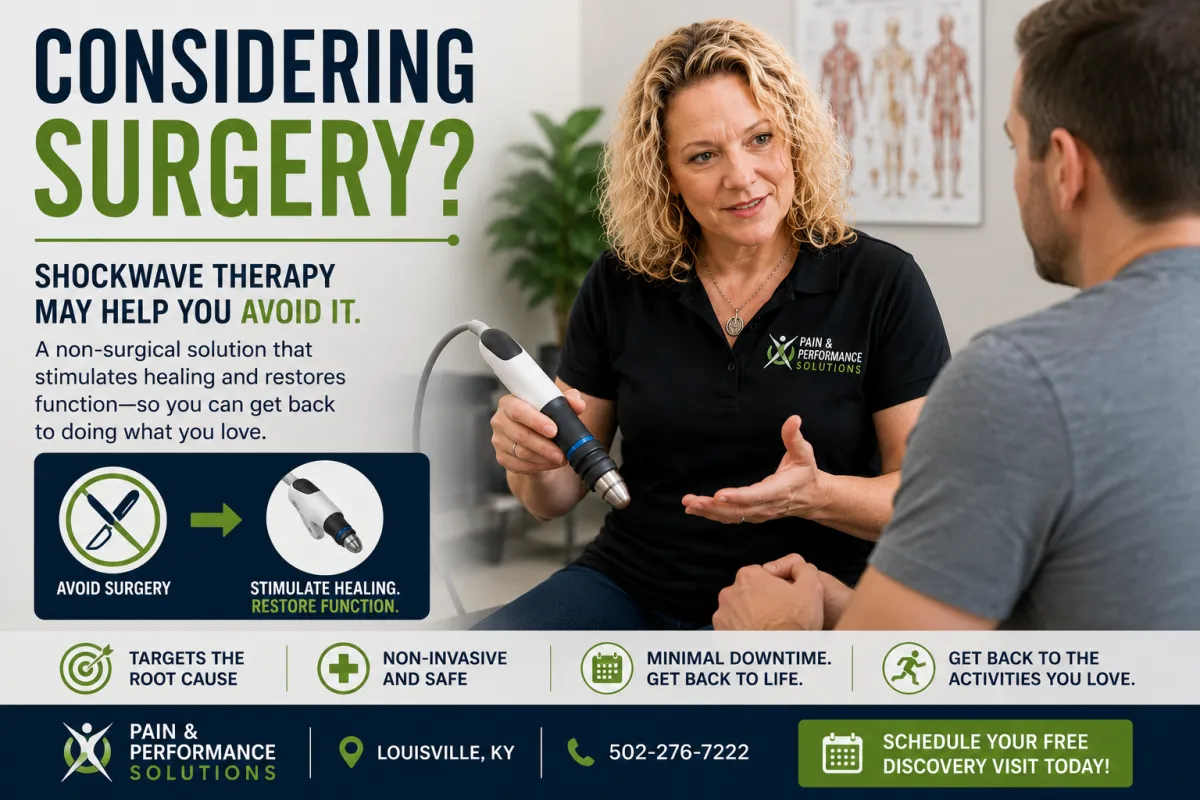
Can Shockwave Therapy Help You Avoid Surgery?
Can Shockwave Therapy Help You Avoid Surgery?
When pain has been limiting your life for months or even years it's natural to start wondering whether surgery is your only option.
Many people seek surgical consultations because they've tried stretching, exercises, injections, medications, or other treatments without finding lasting relief.
The good news is that surgery is not always the next step.
For certain chronic conditions, Shockwave Therapy may provide a non-surgical option that helps stimulate healing and improve function without the risks and recovery time associated with surgery.
Why People Begin Considering Surgery
Most people don't jump straight to surgery.
Typically, they've already tried:
Rest
Physical therapy
Stretching programs
Anti-inflammatory medications
Injections
Orthotics
Activity modification
When symptoms continue despite these efforts, surgery often feels like the only remaining choice.
However, some chronic conditions involve tissues that simply haven't been able to complete the healing process.
How Shockwave Therapy Works
Shockwave Therapy uses high-energy acoustic waves that are delivered directly into injured tissue.
These acoustic waves help stimulate:
Blood flow
Cellular activity
Collagen production
Tissue regeneration
Natural healing responses
Rather than masking symptoms, Shockwave Therapy works by encouraging the body to repair damaged tissue.
Conditions Commonly Treated Before Surgery Is Considered
Shockwave Therapy is frequently used for conditions such as:
Plantar Fasciitis
Many individuals with chronic heel pain are told surgery may eventually become necessary if conservative care fails.
Shockwave Therapy may help stimulate healing within the plantar fascia and improve symptoms without invasive procedures.
Achilles Tendinopathy
Chronic Achilles tendon pain can be frustrating because tendons heal slowly.
Shockwave Therapy may help encourage tissue repair while reducing discomfort and improving function.
Tennis Elbow and Golfer's Elbow
Persistent elbow pain can interfere with work, exercise, and daily activities.
Shockwave Therapy is often used to help stimulate healing in chronic tendon injuries before surgical options are explored.
Rotator Cuff Tendon Pain
Shoulder pain often involves tendon dysfunction that may respond well to non-surgical treatment strategies.
Shockwave Therapy can be incorporated into a comprehensive plan aimed at restoring function and reducing pain.
Why Avoiding Surgery Matters
While surgery can be necessary in certain situations, it also comes with considerations such as:
Recovery time
Rehabilitation requirements
Time away from activities
Potential complications
Additional medical costs
When a safe and effective non-surgical option is available, many patients prefer to explore those options first.
Shockwave Therapy Isn't About Quick Fixes
It's important to understand that Shockwave Therapy isn't designed to provide instant relief.
The treatment works by stimulating healing processes within the body.
As tissues repair themselves, many patients experience:
Reduced pain
Improved mobility
Better function
Increased activity tolerance
Results typically occur gradually as healing progresses.
Why We Look Beyond the Pain
At Pain & Performance Solutions, we don't just focus on the injured tissue.
We also evaluate:
Movement patterns
Compensation strategies
Muscle imbalances
Root-cause contributors
This helps us address both the injury itself and the factors that may have contributed to the problem.
Is Shockwave Therapy Right for You?
Every situation is unique.
Some conditions require surgical intervention.
Others may respond very well to conservative treatment approaches.
A Discovery Visit allows us to evaluate your condition, discuss your goals, and determine whether Shockwave Therapy may be an appropriate option.
Ready to Explore Your Options?
Before assuming surgery is your only path forward, let's discuss whether a non-surgical solution may be available.
Schedule your Free Discovery Visit with Pain & Performance Solutions today.
📍 Louisville, KY
📞 502-276-7222
Discover whether Shockwave Therapy may help you get back to the activities you love.

Book Your Free
Discovery Session
No pressure. No obligation. Just clarity
In your 30-minute session, you’ll:
✔ Get clear on what’s actually causing your pain
✔ Understand your options
✔ Know if we’re the right fit for you
How It Works
1. Fill out a quick form
2. We’ll reach out to learn more about your situation
3. Schedule your free session

Call Us
For immediate assistance or to speak directly with one of our experts, feel free to give us a call.
(502) 276-7222

Visit Us
Drop by our shop to receive personalized service and discuss your needs face-to-face.
9900 Shelbyville Rd Suite 1A, Louisville KY 40223

E-mail Us
Have a question or need more information? Send us an email, and we'll get back to you promptly with the details you need.